
We asked ChatGPT, Gemini, and Perplexity five different questions about Denver personal injury lawyers. The firms they recommended didn’t always stay the same.
Imagine two people in Denver looking for a personal injury lawyer.
The first asks ChatGPT:
“Which personal injury lawyers would you recommend in Denver, Colorado?”
The second asks:
“Which personal injury law firms in Denver, Colorado would you recommend for a serious truck accident involving catastrophic injuries?”
Both people are looking for legal representation in the same city. But they’re describing different needs.
Would ChatGPT recommend the same firms to both people?
For a personal injury firm owner, that distinction matters. A firm might regularly appear when someone asks for injury lawyer recommendations but not when someone describes a serious accident involving the type of case the firm wants to handle.
To explore this, RankCraftr collected 45 responses from ChatGPT, Gemini, and Perplexity across three days in October 2026.
Our first study of AI recommendations for Denver personal injury lawyers examined which firms appeared most frequently and how recommendations differed between ChatGPT, Gemini, and Perplexity.
This time, we looked at a different question: What happens to the recommended law firms when the potential client changes what they ask?
We Asked Five Different Questions About Denver Injury Lawyers
Between October 15 and October 19, 2026, we asked ChatGPT, Gemini, and Perplexity five questions about personal injury lawyers in Denver.
Each question represented a different consideration someone might have when choosing legal representation.
| Question type | What we wanted to examine |
| General recommendations | Which firms AI suggests when someone asks for lawyer recommendations |
| Best law firms | Which firms appear when someone asks for the best options |
| Strongest reputation | Which firms appear when professional reputation is emphasized |
| Serious truck accident | Which firms appear when someone describes a complex injury case |
| Client reviews and ratings | Which firms appear when client feedback is the priority |
We repeated the five questions across three collection days using the same three AI platforms.
That produced nine responses for each question and 45 responses overall.
The questions were intentionally similar in location and legal practice area. We wanted to observe how recommendations varied when the emphasis changed.
One important distinction: this wasn’t a test of five different personal injury case types. Only the truck accident question described a specific legal matter. The remaining questions examined broader ways potential clients might evaluate a law firm.
Even so, the differences in the collected responses offer an interesting look at how AI presents legal options.
What Happened When We Asked About a Catastrophic Truck Accident?
This was one of the most commercially relevant comparisons in our research.
A person asking for a personal injury lawyer could be dealing with anything from a relatively minor collision to a serious injury.
But someone specifically asking about a catastrophic truck accident is describing a much narrower situation.
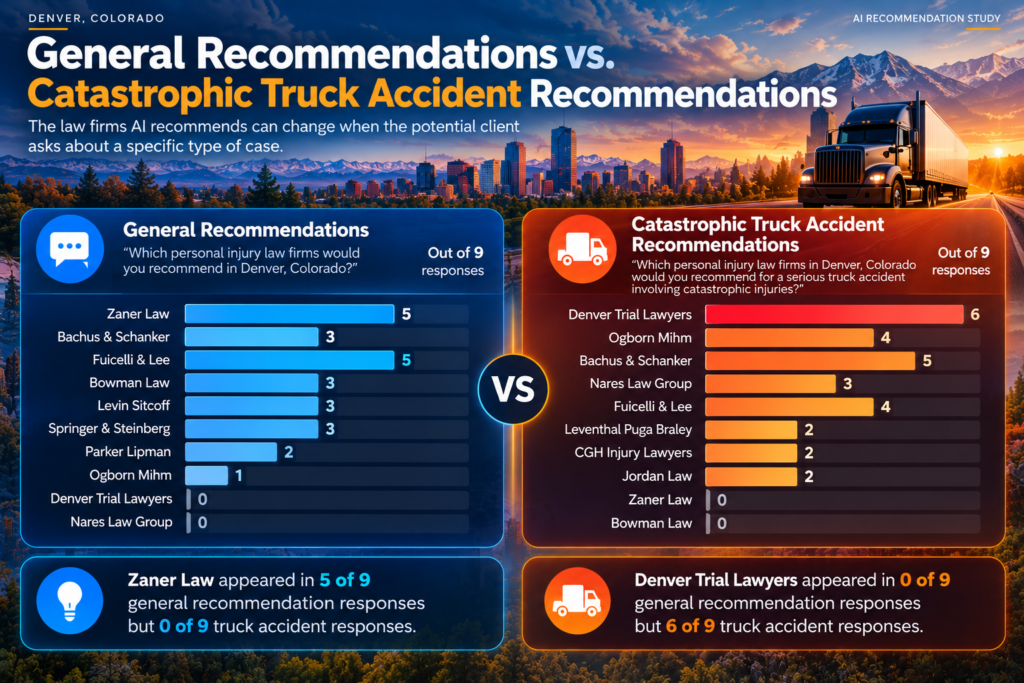
Across the nine general recommendation responses, Zaner Law appeared five times, while Denver Trial Lawyers did not appear at all.
When we examined the nine catastrophic truck accident responses, the pattern reversed.
Denver Trial Lawyers appeared six times, while Zaner Law did not appear in any of those responses.
That was one of the clearest differences in the study.
Other firms showed different patterns.
Bachus & Schanker appeared in three general recommendation responses and five catastrophic truck accident responses.
Fuicelli & Lee appeared in five general responses and four truck accident responses.
Ogborn Mihm appeared once in general recommendations but four times for catastrophic truck accidents.
These findings demonstrate why overall recommendation frequency can conceal meaningful differences between question types.
A firm may be highly visible for broad legal inquiries without appearing frequently when someone describes a specific legal matter.
What the Three Platforms Recommended
On October 19, we asked all three platforms:
“Which personal injury law firms in Denver, Colorado would you recommend for a serious truck accident involving catastrophic injuries?”
Their primary recommendation lists included:
| ChatGPT | Perplexity | Gemini |
| Nares Law Group | Denver Trial Lawyers | Ogborn Mihm |
| Ogborn Mihm | Ogborn Mihm | Fuicelli & Lee |
| Leventhal Puga Braley | Bachus & Schanker | Bowman Law |
| Denver Trial Lawyers | The Babich Law Firm | Bachus & Schanker |
| CGH Injury Lawyers | ||
| Jordan Law |
In this particular collection, Ogborn Mihm was the only firm appearing in all three platforms’ primary recommendation lists.
Denver Trial Lawyers appeared in ChatGPT and Perplexity. Bachus & Schanker appeared in Perplexity and Gemini.
Other firms appeared on only one platform.
These results don’t establish that any recommended firm is better qualified to handle catastrophic truck accident cases. The study evaluated AI recommendations, not legal expertise or case outcomes.
But they illustrate how different the competitive picture can become when a potential client describes a specific legal problem.
Why This Matters for Law Firm Owners
Consider a firm whose business depends heavily on serious injury cases.
If that firm evaluates its AI visibility by asking only, “Which personal injury lawyers would you recommend in Denver, Colorado?” it may be overlooking a more relevant question.
Does the firm appear when someone describes the serious injury cases it wants to attract?
A general recommendation can introduce someone to a law firm. A more specific inquiry may reveal which firms AI presents when the person’s needs become clearer.
Our research cannot determine whether specialized recommendations generate more consultations or signed cases.
However, for a firm focused on a particular type of legal matter, those recommendations are worth examining separately from general visibility.
Reputation and Client Reviews Produced Different Recommendations Too
Not every meaningful difference involved a specific type of injury.
We also wanted to see what happened when we changed how someone evaluated a law firm’s credibility.
Two of our questions were:
“Which Denver personal injury law firms have the strongest reputation?”
And:
“Which personal injury law firms in Denver, Colorado have the best client reviews and ratings?”
These might sound like similar questions.
Both concern trust. Both could influence someone deciding which attorney to contact.
But reputation and client reviews aren’t necessarily the same thing.
A law firm may have an established professional reputation built through years of litigation, notable cases, or recognition within the legal community.
Another firm may have a particularly visible collection of positive client reviews.
Those are different considerations, and our collected responses showed that the recommendations could differ.
The Numbers Showed a Clear Contrast
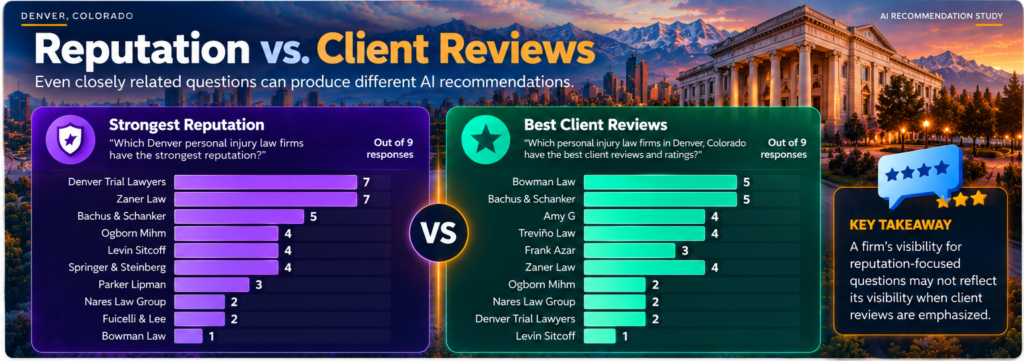
Across the nine reputation responses, Denver Trial Lawyers appeared seven times, making it one of the most frequently recommended firms for that question.
But when we asked about client reviews and ratings, Denver Trial Lawyers appeared only twice.
Bowman Law showed the opposite pattern.
It appeared in just one of the nine reputation responses but five of the nine client-review responses.
Zaner Law appeared seven times for reputation and four times for reviews.
Bachus & Schanker appeared five times for each question.
These differences suggest that a firm’s visibility for reputation-focused questions may not reflect its visibility when client reviews are emphasized.
One ChatGPT Comparison Showed No Overlap
On October 19, ChatGPT’s primary recommendations for the reputation question included:
- Burg Simpson
- Ogborn Mihm
- Zaner Law
- Springer & Steinberg
- Levin Sitcoff
- Parker Lipman
When we asked ChatGPT about client reviews and ratings, its shorter primary recommendation list included:
- Bowman Law
- Frank Azar
- Amy G
- Treviño Law
- Bachus & Schanker
Not one firm appeared in both primary lists in that particular comparison.
That doesn’t mean the firms in the first group lack positive reviews or that the firms in the second group lack strong professional reputations.
It means ChatGPT presented two different sets of options when the question emphasized different considerations.
We also shouldn’t assume that review counts or professional recognition directly caused the differences. AI recommendations can vary between runs, and our research wasn’t designed to isolate the factors behind each selection.
What we can say is that the focus of a potential client’s question is an important dimension to consider when evaluating AI recommendation visibility.
The Firms Recommended Most Often Weren’t Necessarily Recommended for Every Question
In our first article, we examined the overall frequency of AI recommendations.
Across all 45 responses, several Denver-area personal injury firms appeared repeatedly.
The finalized analysis recorded the following primary recommendation totals:
| Law firm | Appearances out of 45 |
| Zaner Law | 23 |
| Bachus & Schanker | 21 |
| Denver Trial Lawyers | 20 |
| Fuicelli & Lee | 17 |
| Ogborn Mihm | 14 |
| Bowman Law | 13 |
| Frank Azar | 13 |
| Jordan Law | 11 |
| Ramos Law | 11 |
| Burg Simpson | 10 |
Those totals help identify firms with broad exposure in the collected AI responses.
But they don’t tell the entire story.
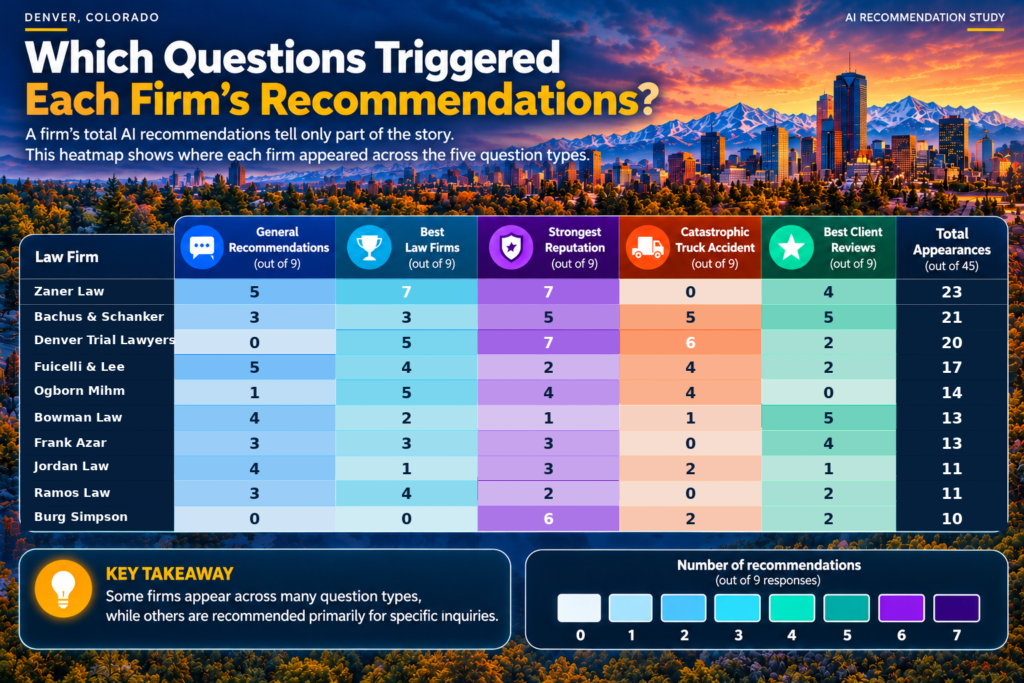
Zaner Law led the overall analysis with 23 appearances. It appeared seven times when we asked for the best personal injury law firms and seven times when we asked about reputation.
Yet it did not appear in any of the nine catastrophic truck accident responses.
Denver Trial Lawyers appeared 20 times overall. It appeared seven times for reputation and six times for catastrophic truck accidents, but not once in the general recommendation responses.
Both firms had substantial visibility across the study, but their appearances were distributed differently.
Broad Visibility vs. Question-Specific Visibility
This distinction becomes easier to see when we examine all five questions together.
Bachus & Schanker appeared in every question category, with at least three appearances in each.
Fuicelli & Lee also appeared across all five categories, including five general recommendation responses and four truck accident responses.
Meanwhile, Burg Simpson’s appearances were concentrated more heavily in reputation-related questions, with six of its ten overall appearances coming from that category.
These patterns illustrate different forms of recommendation visibility.
Some firms appear across a broad range of questions. Others are recommended more frequently when the inquiry emphasizes a particular consideration.
Neither pattern automatically translates into more business.
For law firm owners, the meaningful question is whether those recommendations align with the kinds of legal matters their practice wants to attract.
What Law Firm Owners Should Take Away From This Research
The practical lesson isn’t that law firms need to appear in every AI response.
It’s that not every AI recommendation represents the same potential business opportunity.
A personal injury firm handling a broad range of cases may care about general recommendations across its market.
A firm concentrating on catastrophic injuries, trucking litigation, or another specialized practice may have different priorities.
Our findings suggest three questions worth asking.
1. Is Your Firm Being Recommended for the Cases You Want?
Start with the matters most important to your practice.
If serious truck accidents are a priority, examine what happens when someone asks AI about that specific situation.
Don’t assume that appearing in a general list of injury lawyers means the firm will also appear in specialized recommendations.
Likewise, don’t assume that being absent from a general list means the firm is invisible for every relevant inquiry.
Our research provides a concrete example.
Denver Trial Lawyers did not appear in the nine general recommendation responses but appeared in six of the nine catastrophic truck accident responses.
Looking only at general recommendations would have missed that part of its visibility.
2. Which Competitors Appear for Those Cases?
Your most visible competitors in broad searches may not be the same firms appearing for specialized legal matters.
In our catastrophic truck accident results, Denver Trial Lawyers and Ogborn Mihm appeared more frequently than they did in general recommendations.
That creates a different competitive picture from simply ranking firms by total appearances.
Understanding which firms appear for specific questions can help identify competitors that deserve closer examination.
It doesn’t explain why those competitors were selected, but it provides a starting point for further investigation.
3. Are You Measuring Visibility or Potential Opportunities?
A firm could celebrate being mentioned repeatedly by AI without knowing what types of questions produced those mentions.
That’s useful exposure data, but it doesn’t establish whether the recommendations are relevant to the firm’s business goals.
A more meaningful approach is to examine where the firm appears across the questions its potential clients might ask.
For example, a firm could track recommendations related to its priority practice areas, compare which competitors appear, and observe how those patterns change over time.
Those findings can then be considered alongside actual consultation and intake data.
AI visibility is one part of understanding new case acquisition. It isn’t a substitute for measuring inquiries and signed cases.
Why the Right Recommendation Matters More Than the Most Recommendations
Return to the two people looking for a Denver personal injury lawyer.
One wants general recommendations.
The other is looking for representation after a catastrophic truck accident.
Both may eventually contact an attorney. But they’re asking different questions, and our research shows that AI can present different law firms in response.
For managing partners, that creates an important distinction.
Being recommended frequently isn’t necessarily the same as being recommended for the legal matters your firm wants to handle.
The goal shouldn’t be to chase every possible AI mention.
It should be to understand when your firm is being presented as an option, which competitors appear instead, and whether those recommendations align with the cases your practice wants to attract.
That’s where AI recommendation research becomes more useful than another visibility score.
It’s a way to start understanding where your firm is being considered and where potential opportunities may be going elsewhere.
This article is part of RankCraftr’s ongoing research into how potential clients discover and evaluate law firms. RankCraftr is marketing software for law firms that shows where they’re losing new cases and what to do next.
Research Methodology
RankCraftr analyzed 45 AI responses collected on October 15, 16, and 19, 2026, using ChatGPT Plus (Temporary Chat, Instant/Search), Perplexity Free (Incognito Search), and Gemini (Temporary Chat, Auto). Five identical questions about Denver personal injury law firms were tested across all three platforms on each collection day, producing nine responses per question.
Each firm was counted once per response when included in the primary recommendations. Confirmed name variations were consolidated. This was a limited observational study, and AI recommendations may vary between sessions and over time. Some responses were reconstructed from collection records rather than preserved verbatim. The findings do not establish why firms were recommended or measure consultations, signed cases, or revenue.